

If you’re searching for Johnstown, PA renters insurance quotes, comparing several insurers can help you find coverage that protects your belongings, offers personal liability protection, and fits your monthly budget. Renters insurance can cover eligible losses involving furniture, clothing, electronics, and other personal possessions, along with certain additional living expenses after a covered event. The right policy depends on your belongings, rental property, deductible, and coverage limits.
For renters in Johnstown, Pennsylvania, the goal isn’t simply to find the lowest price. It’s to understand what each policy covers, what it excludes, and how much financial protection you’ll receive if something goes wrong.
According to the Pennsylvania Insurance Department, renters insurance commonly costs around $15 to $30 per month, although individual premiums vary. Recent 2026 estimates from NerdWallet put Johnstown’s average at approximately $126 per year, or $11 per month, for the coverage used in its comparison. These are different benchmarks, not guaranteed quotes for every renter.
Commonwealth of Pennsylvania
+1
This guide explains how to compare prices, understand coverage, identify potential savings, and choose a renters insurance policy for your home or apartment in Johnstown.
How to Compare Johnstown, PA Renters Insurance Quotes 🏠
Getting several quotes is one of the simplest ways to understand your options. Insurance companies can charge different premiums for similar-looking policies, so accepting the first price you see may mean missing a better fit.
However, a meaningful comparison requires more than lining up monthly payments. Two policies might have different personal property limits, deductibles, liability protection, and rules for paying claims.
Start with your personal property
Before requesting quotes, estimate the cost of replacing the things you own. Include items you might overlook, such as kitchen equipment, shoes, bedding, cleaning appliances, books, and small electronics.
For example, imagine you need to replace your:
- Sofa, bed, dining table, and other furniture.
- Television, laptop, tablet, and gaming equipment.
- Clothes, shoes, coats, and accessories.
- Kitchen appliances, cookware, and dishes.
- Personal items, sports equipment, and decorations.
The replacement cost can be higher than expected when you add everything together. Creating a simple home inventory helps you choose a personal property limit based on your actual needs instead of guessing.
Request comparable quotes
Use the same basic information when requesting estimates from different insurers. This makes it easier to see whether a lower premium reflects a better price or simply less coverage.
| Quote detail | What to compare |
| Monthly or annual premium | Your total policy cost |
| Personal property limit | Maximum coverage for eligible belongings |
| Personal liability | Protection against covered claims involving injury or property damage |
| Deductible | Amount you generally pay toward a covered property claim |
| Loss of use | Eligible additional living expenses after a covered loss |
| Settlement method | Actual cash value or replacement cost |
| Exclusions | Events or property the policy doesn’t cover |
The Pennsylvania Insurance Department recommends reviewing coverage options and shopping around rather than assuming every policy provides the same protection.
Commonwealth of Pennsylvania
+1
Compare the same coverage limits
Suppose one insurer offers a lower premium but provides less personal property coverage. Another costs a little more but offers replacement cost coverage and a more suitable liability limit.
The cheaper policy isn’t automatically the better deal.
Ask each insurer to quote similar coverage limits and deductibles. Then compare the policy details, including special limits on valuables and exclusions for particular types of damage.
Check the insurer and agent
Before buying, verify that the insurance company or agent is authorized to sell insurance in Pennsylvania. You can begin with the Pennsylvania Insurance Department’s, which provides resources for researching insurers and agents.
Commonwealth of Pennsylvania
You can also review the insurer’s claims process, available customer support, payment options, and policy cancellation rules.
A useful rule: Compare at least three quotes when practical, keep the coverage details consistent, and choose the policy that offers the best balance of protection, price, and service.
How Much Does Renters Insurance Cost in Johnstown, PA? 💵
The price of renters insurance depends on the policy and the renter. Your address, building characteristics, coverage limits, deductible, claims history where applicable, and selected options can all influence the premium.
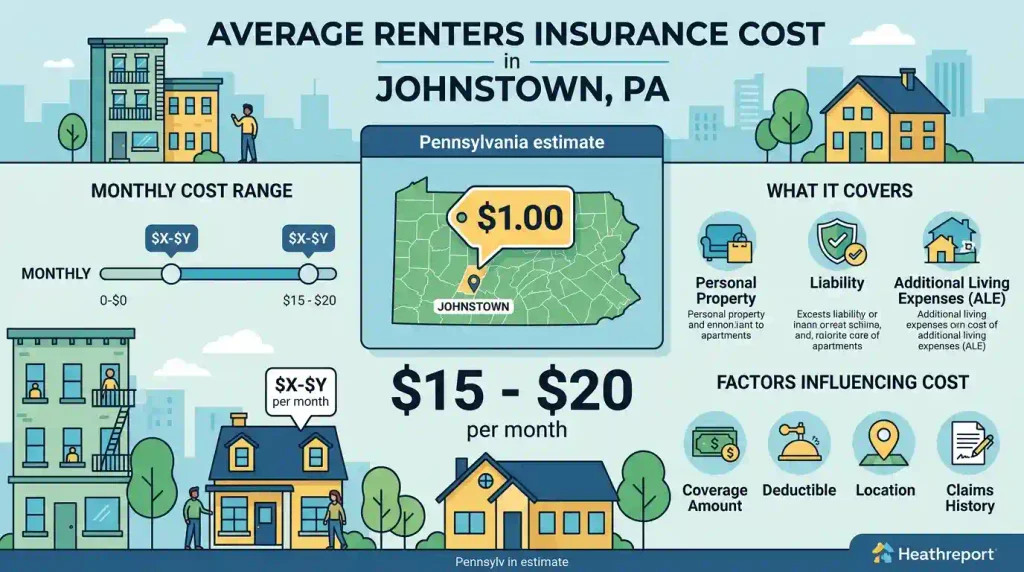
There is no single price that applies to every apartment in Johnstown.
Understanding local cost estimates
Two published figures offer a starting point for budgeting:
Pennsylvania Insurance Department benchmark
$15 to $30/month
General guidance for renters insurance policies.
NerdWallet’s Johnstown estimate for 2026
$126/year
Approximately $10.50/month in its comparison.
Sources:
Commonwealth of Pennsylvania
+1
These are reference estimates, not live offers or a prediction of your individual premium.
The difference between these figures doesn’t necessarily indicate that one source is wrong. Estimates may use different assumptions, coverage limits, deductibles, insurer samples, and calculation methods.
Your actual quote may be lower or higher.
What affects your premium?
Several factors may influence the amount you pay.
- Coverage amount: Higher personal property limits generally increase the insurer’s potential payout and may increase the premium.
- Deductible: Choosing a higher deductible may lower your premium, but you will need to pay more yourself when a covered claim occurs.
- Rental address: Location-related risks and property characteristics can affect pricing.
- Building features: Security measures, fire protection, and other property details may influence eligibility or discounts.
- Claims history: An insurer may consider your claims history when calculating its offer.
- Optional protection: Extra coverage for certain valuables or specific risks may add to the cost.
- Insurance discounts: Bundling eligible policies or qualifying for protective-device discounts may reduce your premium.
The exact effect varies by company, so ask insurers which factors influence your quote.
Estimate your yearly budget
A simple way to compare offers is to convert the monthly payment into an annual amount.
| Monthly premium | Annual premium |
| $10 | $120 |
| $12 | $144 |
| $15 | $180 |
| $20 | $240 |
| $25 | $300 |
| $30 | $360 |
These are mathematical examples, not current offers from specific insurers.
Remember to check whether a quoted amount includes all applicable fees and whether the displayed price assumes monthly installments or payment for the full term.
Is the cheapest policy worth it?
Sometimes. A low-cost policy can be a sensible choice if it provides enough coverage and has acceptable terms.
But a very low premium may reflect a high deductible, limited personal property protection, actual cash value settlement, or exclusions that matter to you.
Consider the total financial picture. You want a policy you can afford to maintain and that provides useful protection when you need it.
What Does Renters Insurance Cover? 🛡️
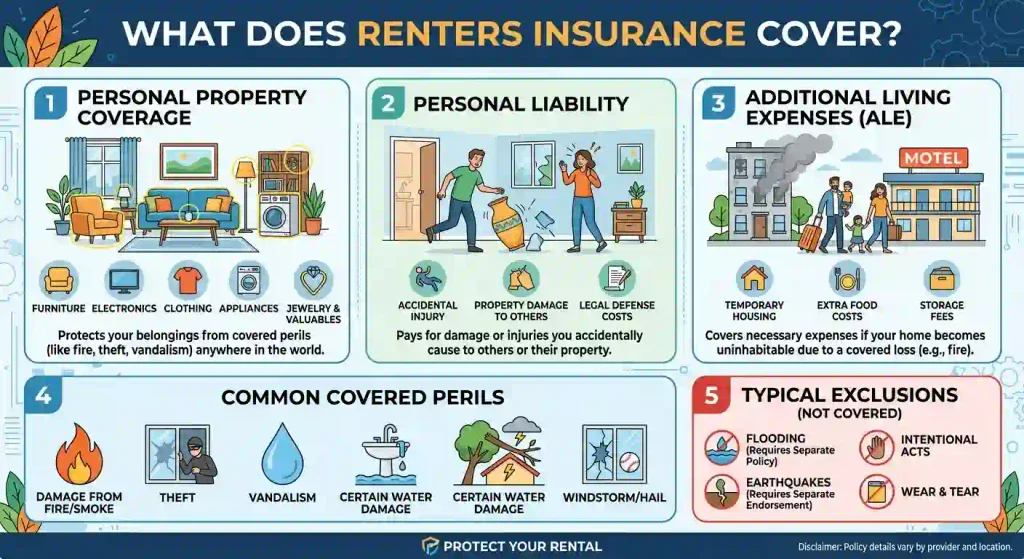
Renters insurance is designed to protect tenants against certain financial losses. A standard policy commonly includes personal property coverage, personal liability coverage, and additional living expenses after a covered loss. The exact terms depend on the policy you purchase.
NAIC Content
+1
Understanding these categories helps you choose coverage that makes sense for your apartment or rented house in Johnstown.
Personal property coverage
Personal property coverage can help repair or replace eligible belongings if they’re damaged, destroyed, or stolen in a covered event.
Depending on your policy, covered belongings may include:
- Furniture and mattresses.
- Clothing, shoes, and accessories.
- Computers, televisions, and other electronics.
- Kitchenware and household equipment.
- Books, toys, and personal decorations.
- Certain sports and recreational equipment.
Some policies also protect covered belongings away from home. For example, eligible property stolen from a hotel room or your vehicle may be covered, subject to the policy’s terms and limits.
NAIC Content
+1
Don’t assume every loss is covered. A policy may cover theft but exclude certain causes of damage, and special limits may apply to valuable items.
Personal liability coverage
Personal liability coverage can help protect you financially if you’re legally responsible for covered bodily injury or property damage to another person.
Imagine a visitor slips in your apartment and claims that your negligence caused the injury. Depending on the circumstances and policy terms, liability coverage may help with covered legal expenses or damages.
It may also apply if you accidentally damage someone else’s property. Coverage is subject to the policy’s exclusions, conditions, and liability limit.
When comparing Johnstown renters insurance quotes, check the available liability limits and choose an amount that reflects your circumstances.
Medical payments to others
Some renters policies include a limited amount of medical payments coverage for eligible injuries to visitors. This coverage is distinct from personal liability insurance and may apply without a finding that you’re legally responsible.
The amount available and the circumstances in which it applies depend on the contract.
Additional living expenses
Imagine a covered fire makes your rental home temporarily uninhabitable. You might need to stay in a hotel, eat at restaurants more often, or pay other necessary expenses while repairs take place.
Additional living expenses coverage, sometimes called loss of use coverage, may help pay eligible extra costs during that period.
It doesn’t automatically pay every expense or guarantee unlimited temporary housing. Your policy will specify applicable limits, conditions, and the losses that qualify.
What renters insurance usually doesn’t cover
One of the most important steps is learning what your policy excludes.
Common limitations include the following:
- Flood damage: Standard renters policies generally exclude damage caused by flooding from outside sources. Separate flood insurance may be necessary.
- Earthquake damage: Earthquake protection may require a separate policy or endorsement.
- Normal wear and tear: Gradual deterioration and maintenance problems generally aren’t covered by insured events.
- Pest infestations: Damage from insects or rodents is commonly excluded.
- Intentional damage: Losses caused intentionally by the insured are generally excluded.
- Certain high-value items: Jewelry, collectibles, and other valuables may have special limits that require additional coverage.
These are general examples, not a definitive list of exclusions in every policy. Review the actual contract and ask the insurer about any situation you’re concerned about. Pennsylvania’s insurance guidance also recommends checking whether relevant storm and flood risks are covered.
Commonwealth of Pennsylvania
+1
Does your landlord’s insurance cover your belongings?
Usually, no. A landlord’s policy generally protects the building owner’s property and liability interests, not your personal possessions.
If a covered fire damages your sofa, clothing, and laptop, your landlord’s building insurance doesn’t automatically reimburse you for those items. Your own renters policy may provide that protection if the loss qualifies under its terms.
Commonwealth of Pennsylvania
+1
This distinction matters whether you rent a studio apartment, a house, or a unit in a larger apartment building.
Renters Insurance and Local Risks in Johnstown, PA 🌧️
Johnstown renters should consider the physical risks associated with their particular rental property when choosing coverage. The right questions depend on the building, its location, its maintenance, and the types of events that could damage your belongings.
A city’s general risk profile cannot tell you exactly what will happen to an individual property. However, thinking about possible losses can help you identify coverage gaps before purchasing insurance.
Understand the difference between water damage and flooding
Water-related losses can be confusing because policies may treat different causes differently.
For example, a sudden plumbing leak may be covered under a renters policy, depending on the circumstances. Floodwater entering a home from outside is generally excluded under standard renters insurance.
That difference is important when comparing policies.
Ask the insurer these questions:
- Is accidental water damage from a burst pipe covered?
- What happens if a roof leak damages my personal belongings?
- Does the policy exclude surface water or flooding?
- Would I need separate flood insurance for my possessions?
- Are there special conditions involving frozen pipes or unattended properties?
Don’t assume that the phrase “water damage covered” means every type of water loss qualifies.
Consider flood exposure at your specific address
Pennsylvania experiences flooding, and the state Insurance Department provides guidance on flood insurance and natural disaster preparedness. Standard renters insurance typically does not cover flood damage.
NerdWallet
+1
If your rental is near a creek, river, low-lying area, or location with a history of flooding, investigate the property’s exposure rather than relying on a citywide average.
You can use the official to investigate mapped flood hazards. A map is a useful starting point, but it doesn’t guarantee that a property outside a mapped high-risk area cannot flood.
Ask your insurer or agent whether separate flood insurance for personal belongings is available and appropriate for your circumstances.
Prepare for storms, fire, and winter weather
Weather and building-related incidents can cause substantial disruption, even when the damage is limited to one rental unit.
A practical checklist includes:
- Confirm whether your policy covers qualifying wind, hail, smoke, and fire damage.
- Ask how the policy treats frozen or burst pipes.
- Keep your contact details and policy documents accessible.
- Photograph valuable possessions and save purchase receipts where possible.
- Know how to report a claim and arrange emergency repairs through the appropriate parties.
The Pennsylvania Insurance Department recommends keeping policy information safe and documenting belongings with photos or videos.
Commonwealth of Pennsylvania
Check your rental agreement
Some landlords require renters insurance as a condition of the lease. Others may recommend it without making it mandatory.
Read your lease carefully. If coverage is required, confirm the minimum limits, any liability requirements, the required effective date, and whether the landlord needs proof of insurance.
Don’t assume that every lease has the same conditions. If a requirement is unclear, ask the landlord or property manager to explain it in writing.
Protect belongings without paying for unnecessary coverage
A renter with basic furniture and a few electronic devices may have different insurance needs from someone with expensive photography equipment, musical instruments, or a large collection of jewelry.
Think about the property you actually own and the risks you want to insure. Then ask about policy limits and optional coverage for items that may not be fully protected by a standard policy.
The goal is practical protection, not paying for options you don’t need or overlooking coverage that matters.
How to Save Money on Renters Insurance in Johnstown 💡
Affordable renters insurance is about finding the right policy at a competitive price. You don’t necessarily need to sacrifice important coverage to lower your premium.
Try these approaches when comparing Johnstown, PA renters insurance quotes.
Compare several insurance companies
Start with your current auto insurer, if you have one, and compare its offer with quotes from other companies.
You can also check insurers that sell policies online and independent insurance agents who can help you explore multiple carriers.
Use the same property coverage limit, liability limit, and deductible when possible. This gives you a clearer picture of which company offers the best value.
Ask about bundling discounts
Some insurers offer discounts when you purchase renters and auto insurance together. Other discounts may be available for eligible protective devices or payment arrangements.
The Pennsylvania Insurance Department specifically identifies policy bundling and certain safety measures as potential ways to save.
Commonwealth of Pennsylvania
+1
Ask about:
- Renters and auto insurance bundles.
- Qualifying security systems and deadbolts.
- Fire alarms and sprinkler systems.
- Discounts for paying the policy in full.
- Other discounts available through your insurer.
Discount availability varies. Request the actual premium after discounts rather than assuming that a discount automatically makes a policy the cheapest option.
Choose a deductible you can afford
A deductible is the amount you generally pay toward a covered property claim before the insurer pays the eligible remainder.
A higher deductible may lower your premium. However, the savings need to justify the additional out-of-pocket risk.
Consider a simple hypothetical example:
| Policy option | Deductible | Annual premium |
| Policy A | $250 | $180 |
| Policy B | $500 | $150 |
| Policy C | $1,000 | $120 |
These figures are illustrative only, not actual Johnstown insurance offers.
Policy C costs $60 less per year than Policy A, but it has a deductible that’s $750 higher. If you make a covered claim, that extra potential expense could outweigh several years of premium savings.
Before choosing a higher deductible, consider whether you could comfortably pay it after an unexpected loss.
Avoid buying too little coverage
Reducing your personal property limit may lower the premium, but it can leave you underinsured.
Make a home inventory and estimate what it would cost to replace your belongings at current prices. Include everyday items, not just expensive electronics or furniture.
Also check whether the policy uses actual cash value or replacement cost for covered property claims. The distinction can make a substantial difference in the amount you receive.
Consider replacement cost coverage
Actual cash value generally accounts for depreciation. Replacement cost coverage generally calculates eligible reimbursement based on replacing the damaged or stolen item with a comparable new item, subject to the policy terms and limits.
For instance, an older laptop may be worth considerably less today than it cost when purchased. Under actual cash value coverage, depreciation can reduce the claim payment.
Replacement cost coverage may provide more money toward a comparable replacement, although the premium can be higher and conditions may apply.
NAIC Content
+1
Compare both options before deciding that a lower premium is the better deal.
Keep your inventory up to date
Take photos or videos of your possessions and store copies somewhere safe. Keep receipts for valuable items when available.
An inventory won’t necessarily reduce your premium, but it can help you document a claim and select a more appropriate coverage limit.
Update it when you purchase expensive electronics, furniture, or other belongings.
Review your policy every year
Your insurance needs can change when you move, buy new possessions, acquire valuable equipment, or change roommates.
Compare renewal pricing with other available offers and check whether the coverage still fits your situation. If your insurer changes its terms or premium, ask for an explanation.
A short annual review can help you avoid paying for unsuitable coverage or keeping limits that no longer match your belongings.
Get a quote before signing your lease
If you’re moving to Johnstown, request renters insurance quotes before your move-in date. This gives you time to compare policies, clarify lease requirements, and arrange coverage to begin when needed.
If you’ve already moved in, you can still purchase renters insurance. Check the effective date and any applicable waiting periods or restrictions rather than assuming protection starts before the policy takes effect.
Commonwealth of Pennsylvania
+1
Frequently Asked Questions About Johnstown Renters Insurance ❓
How much is renters insurance in Johnstown, PA?
NerdWallet’s 2026 comparison estimates approximately $126 per year for Johnstown, while the Pennsylvania Insurance Department gives a general benchmark of $15 to $30 per month. Your price depends on your coverage, deductible, rental address, and insurer. Request personalized quotes to establish your actual cost.
NerdWallet
+1
What is the cheapest renters insurance in Johnstown?
There isn’t one insurer that’s guaranteed to be cheapest for every renter. Rates vary according to the person, property, and selected coverage. Compare several personalized quotes using the same limits and deductibles, and review the insurer’s exclusions before choosing.
Is renters insurance required in Pennsylvania?
Renters insurance is not a universal legal requirement for every tenant in Pennsylvania. However, a landlord may require it under a lease. Check your rental agreement for specific insurance requirements before signing or renewing.
Does renters insurance cover flooding in Johnstown?
Standard renters insurance generally excludes flood damage caused by outside flooding. Separate flood insurance may be needed to protect your belongings. Check the policy wording and investigate the flood exposure of your particular rental property before purchasing coverage.
NerdWallet
+1
Does renters insurance cover my belongings outside my apartment?
Many policies provide some coverage for personal belongings away from home, including certain theft losses while traveling or from a vehicle. Coverage depends on the policy, location of the loss, item limits, deductible, and exclusions. Ask your insurer how off-premises coverage works.
Can I get renters insurance if I have roommates?
Yes, you can generally explore getting your own renters insurance policy when sharing a house or apartment. Don’t assume your roommate’s policy automatically covers your possessions or liability. Pennsylvania’s Insurance Department advises renters to ensure they are named on a shared policy or have their own coverage.
Commonwealth of Pennsylvania
How much personal property coverage should I buy?
Estimate the cost of replacing your belongings, including furniture, clothing, electronics, kitchenware, and other household items. Choose a limit that reflects their total value, and check whether expensive possessions need additional coverage.
How quickly can renters insurance begin?
The effective date depends on the insurer and policy arrangements. Some policies can begin quickly after purchase, but you should confirm the exact start date and any restrictions with the company. Don’t assume that a newly purchased policy will cover a loss that happened before coverage began.
Conclusion
Comparing Johnstown, PA renters insurance quotes doesn’t have to be complicated. Start by estimating the value of your belongings, decide how much liability protection you need, and compare several policies with similar limits and deductibles.
Pay attention to flood exclusions, replacement cost coverage, and available discounts. A little research now can help you avoid unpleasant surprises later.
Your next step is simple: request a few personalized quotes, read the policy details, and choose coverage that fits your budget and your rental home. The best policy is one you can afford and understand before you ever need to use it.