
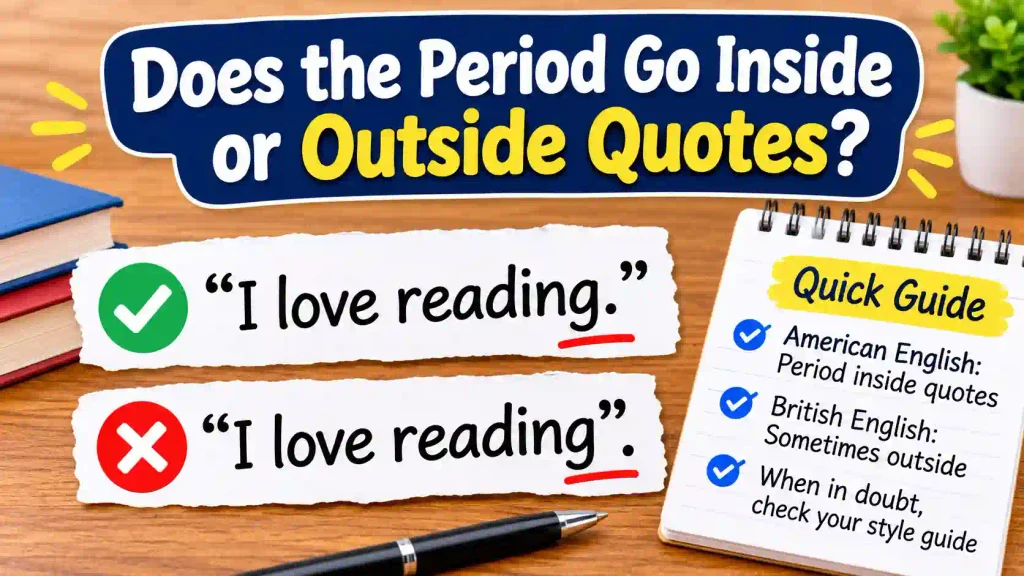

Does the period go inside or outside quotes? In American English, the period almost always goes inside the closing quotation mark, even when it is not part of the original quoted material. For example, write “I love reading.” rather than “I love reading”. This rule applies to most everyday writing, including essays, emails, text messages, articles, and social media captions. However, British English follows a different approach in certain situations. Understanding the difference will help you use quotation marks and periods correctly without second-guessing your punctuation.
Quotation marks help readers recognize someone’s exact words, titles, and special expressions. Periods show where a sentence ends. When these two punctuation marks appear together, their placement can depend on the writing style you’re following.
The good news? American English has a fairly simple rule. Once you understand it, placing periods around quotation marks becomes much easier.
1. 🇺🇸 Does the Period Go Inside or Outside Quotes in American English?
In American English, periods and commas generally go inside closing quotation marks. This is one of the most recognizable punctuation conventions in American writing.
For example:
- Correct: She said, “I’ll call you tomorrow.”
- Incorrect: She said, “I’ll call you tomorrow”.
Notice that the period appears before the closing quotation mark. Even though the period might not have appeared in the original spoken sentence, American style places it inside the quotation marks.
This convention applies to ordinary sentences, quoted expressions, dialogue, and many other writing situations.
Here are 15 examples showing how the rule works in everyday writing.
- My teacher said, “Practice makes progress.”
- She whispered, “Everything will work out.”
- He wrote, “Please check your email.”
- The sign reads, “Keep the door closed.”
- Mom reminded me, “Finish your homework first.”
- I heard someone shout, “Watch your step!”
- Sarah explained, “The meeting starts at nine.”
- My favorite saying is “Stay curious.”
- The article begins with “A fresh perspective.”
- He simply replied, “Not today.”
- The message said, “Your package has arrived.”
- Our coach announced, “Training starts tomorrow.”
- She always says, “Kindness costs nothing.”
- The teacher wrote, “Read the instructions carefully.”
- Dad told us, “Dinner is ready.”
Why does this rule matter?
Consistency makes writing easier to read. If you’re writing for an American audience, placing periods inside quotation marks is generally the expected convention.
It also applies whether you’re writing formally or casually. You don’t need to change the rule just because you’re writing a quick social media post instead of an academic paper.
One important detail: American punctuation rules generally place periods inside quotation marks even when the quoted words are only part of a larger sentence.
2. ✍️ When the Period Belongs Inside Quotation Marks
The period belongs inside the closing quotation mark in standard American English, including when you quote a complete sentence or use a quoted phrase at the end of your own sentence.
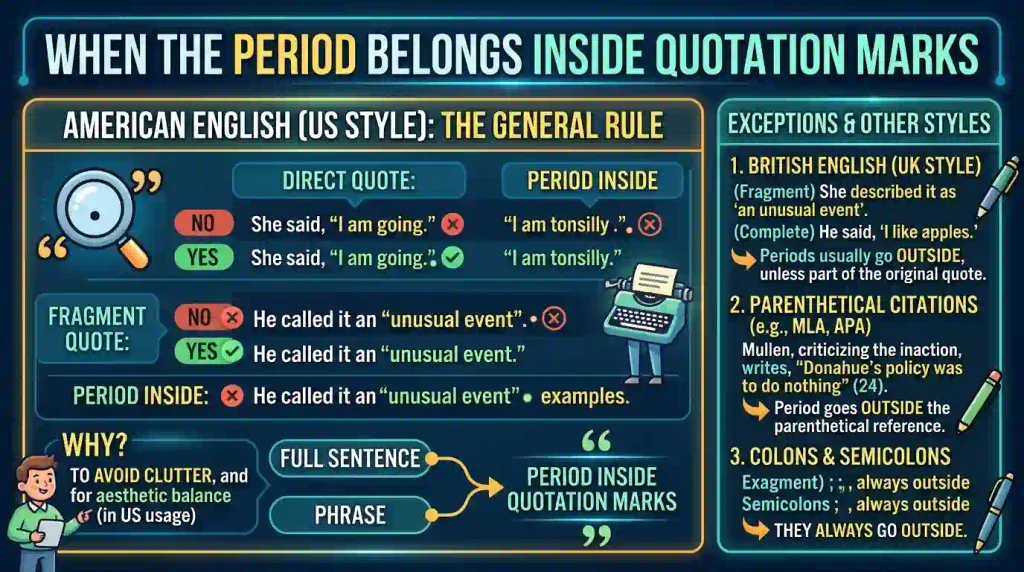
This is particularly useful when writing dialogue, reporting someone’s statement, or including a short quotation in an article.
Consider these examples:
- The announcement stated, “The library closes at six.”
- He asked everyone to “remain calm.”
- My sister described the movie as “surprisingly entertaining.”
- The invitation reads, “Join us this Saturday.”
- She called the experience “a wonderful surprise.”
- The author writes, “Every choice has consequences.”
- Our manager requested, “Submit your reports today.”
- The website promises “fast and reliable service.”
- He described the restaurant as “a hidden gem.”
- The note simply said, “Thank you for everything.”
- She introduced her project as “A Better Tomorrow.”
- The customer called the service “excellent.”
- The instructions clearly state, “Turn off the machine.”
- My friend considers patience “a valuable skill.”
- The headline reads, “New Opportunities Ahead.”
What about a quoted phrase rather than a complete sentence?
The same American convention applies.
For example:
- Correct: She described the performance as “absolutely brilliant.”
- Incorrect: She described the performance as “absolutely brilliant”.
The quotation marks identify the expression being discussed, while the period finishes the written sentence.
You might also notice that the period sometimes appears to be part of the quotation even when the original expression was only a few words long.
That’s normal in American English.
A useful writing tip: When editing an article, don’t move the period outside quotation marks simply because the quoted words are not a complete sentence. Follow the standard American placement rule.
3. 📚 When Quoting Only Part of a Sentence
Sometimes you don’t need to quote an entire sentence. You might want to highlight a phrase, a few important words, or a particular expression.
This happens frequently in essays, blog posts, research papers, interviews, and everyday conversations.
In American English, the period still goes inside the closing quotation mark.
For example, imagine someone describing a new book. You might write:
The reviewer called it “a surprisingly thoughtful story.”
The quoted phrase is not a complete sentence by itself, but the period still appears inside the quotation marks.
Here are 15 additional examples.
- The teacher described his answer as “quite impressive.”
- Her presentation included the phrase “small steps matter.”
- I found the ending “unexpected but satisfying.”
- The report mentioned “significant improvements.”
- He called the suggestion “worth considering.”
- The reviewer praised its “beautiful storytelling.”
- My friend described the trip as “pure adventure.”
- The article highlighted “important environmental changes.”
- She considered the decision “a major achievement.”
- The customer requested “a full refund.”
- The writer used the expression “beyond expectations.”
- His speech emphasized “the value of teamwork.”
- The company advertised “affordable everyday solutions.”
- The teacher called the explanation “clear and helpful.”
- I especially liked the phrase “a world of possibilities.”
How to avoid punctuation mistakes with partial quotations
Keep these three points in mind:
- Identify the exact words you’re quoting.
- Put quotation marks around those words.
- Place the period inside the closing quotation mark when following American English conventions.
You should also avoid changing the original speaker’s meaning. A partial quotation should represent the intended message accurately.
This is especially important in academic writing and journalism, where quotation accuracy matters.
4. 💬 Periods Inside Quotation Marks in Dialogue and Conversations
Dialogue is another common place where writers wonder about period placement.
Whenever a character finishes speaking, American English generally places the period before the closing quotation mark.
This convention appears in novels, short stories, scripts, interviews, and everyday examples of reported speech.
For instance:
“Please wait for me,” Emily said.
“The train leaves soon,” Daniel replied.
In both examples, the punctuation appears inside the quotation marks.
Here are 15 original dialogue examples demonstrating correct American punctuation.
- “I’ll meet you after school,” Jake promised.
- “The weather looks wonderful,” Emma observed.
- “Please bring your notebook,” the teacher requested.
- “We should leave early,” Olivia suggested.
- “That sounds like a great idea,” Noah replied.
- “I finished the assignment,” Mia announced.
- “The restaurant opens at noon,” Dad explained.
- “Don’t forget your keys,” Mom reminded him.
- “I’ll send the details tonight,” Sarah promised.
- “This book is fascinating,” Daniel commented.
- “Let’s discuss it tomorrow,” the manager suggested.
- “The results look promising,” the researcher said.
- “I appreciate your help,” Lily responded.
- “We finally made it,” Ethan celebrated.
- “Everything is ready,” the host announced.
What if the dialogue ends the entire paragraph?
The punctuation remains inside the quotation marks.
For example:
“Thank you for coming. I hope you enjoyed the evening.”
Both periods appear inside their respective closing quotation marks because each quoted sentence has its own ending punctuation.
What if a speaker says several sentences?
Place the appropriate punctuation inside the quotation marks for each sentence.
For example:
“First, read the instructions. Then complete the exercise.”
This makes dialogue easier to understand and keeps the punctuation consistent.
A good habit is to read dialogue aloud while proofreading. It can help you spot missing punctuation and awkward sentence endings.
5. 🔍 Periods With Single Quotes, Double Quotes, and Nested Quotes
Quotation marks come in different forms. American English commonly uses double quotation marks for direct quotations and single quotation marks for a quotation inside another quotation.
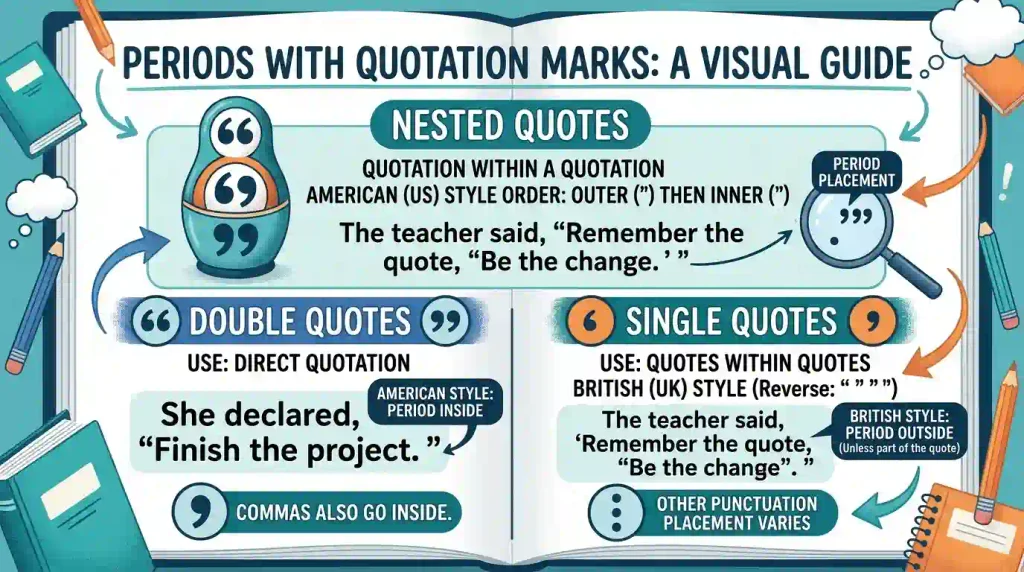
This second situation is known as a nested quotation.
For example:
Mia said, “The teacher called it ‘an excellent effort.'”
The outer quotation uses double quotation marks, while the inner expression uses single quotation marks.
The period appears inside the final closing quotation mark.
Here are 15 examples covering different quotation situations.
- He said, “She called the plan ‘remarkable.'”
- Anna explained, “The phrase was ‘perfectly understandable.'”
- The teacher remarked, “His answer was ‘particularly thoughtful.'”
- John said, “I heard someone shout ‘Fire!'”
- She wrote, “The title was ‘A New Beginning.'”
- David explained, “The phrase ‘time will tell’ fits.”
- Mom said, “Grandma called it ‘a lovely surprise.'”
- The article described it as “a ‘once-in-a-lifetime’ opportunity.”
- He announced, “Our theme is ‘Building Better Habits.'”
- Sarah said, “The word ‘confidence’ changed my perspective.”
- The reviewer called it “a ‘must-read’ for beginners.”
- The teacher explained, “The expression ‘practice makes progress’ matters.”
- She said, “His nickname was ‘Professor.'”
- The author described the scene as “a ‘beautifully written’ moment.”
- Mark explained, “The message simply read ‘Welcome home.'”
Should you use single or double quotation marks?
For standard American English writing, use:
- Double quotation marks for ordinary direct quotations.
- Single quotation marks for a quotation within another quotation.
For example:
“The coach said, ‘Keep working hard,’ before practice.”
This approach helps readers distinguish between the main quotation and the words quoted inside it.
What about titles and special expressions?
Quotation marks can also identify titles of shorter works, such as articles, poems, songs, and short stories, depending on the style guide.
For example:
- I enjoyed reading “The Last Question.”
- Her favorite poem is “A Quiet Morning.”
- We discussed “The Power of Words.”
The American period-placement convention generally remains the same.
6. 🌍 American vs. British English: Does the Period Go Outside Quotes?
This is where things become a little more interesting.
American and British English don’t always follow the same quotation punctuation conventions.
In American English, periods and commas generally go inside closing quotation marks.
British English often follows a logical punctuation approach. This means punctuation can remain outside quotation marks when it does not belong to the quoted material.
For example:
American English
She described the book as “interesting.”
Period inside
British English, logical punctuation
She described the book as “interesting”.
Period outside
Both examples can be correct within their respective conventions.
Here are 15 examples illustrating how punctuation placement can differ.
- American: She called it “wonderful.”
- British: She called it “wonderful”.
- American: He described the idea as “brilliant.”
- British: He described the idea as “brilliant”.
- American: The label reads “Fragile.”
- British: The label reads “Fragile”.
- American: They considered it “unusual.”
- British: They considered it “unusual”.
- American: The reviewer called it “excellent.”
- British: The reviewer called it “excellent”.
- American: She described the result as “unexpected.”
- British: She described the result as “unexpected”.
- American: The article called it “important.”
- British: The article called it “important”.
- American: He considered the experience “memorable.”
- British: He considered the experience “memorable”.
- American: The speaker described it as “inspiring.”
- British: The speaker described it as “inspiring”.
Does British English always put periods outside quotation marks?
No. That is an important distinction.
British punctuation depends on whether the punctuation belongs to the quoted material.
For example:
- She called the performance “excellent”.
- He asked, “Are you coming?”
- She replied, “I’ll be there.”
The period in the first example falls outside the quotation marks because it belongs to the larger sentence, not the quoted word.
In the other examples, the question mark and period belong to the quoted sentences.
Which convention should you follow?
Your choice should depend on your audience and the publication’s preferred style.
- For American audiences: Use American punctuation conventions.
- For British audiences: Follow the publication’s British style guide.
- For academic writing: Follow the required style guide, such as APA, MLA, or Chicago.
- For international websites: Choose one consistent convention and apply it throughout your content.
If your website mainly targets American readers, the simplest choice is to follow American English punctuation rules.
Frequently Asked Questions
1. Does the period go inside or outside quotation marks in American English?
In standard American English, the period goes inside the closing quotation mark. For example, write “I enjoyed the movie.” This convention applies even when quoting a short phrase rather than a complete sentence.
2. Does the period go outside quotation marks in British English?
It can. British English often uses logical punctuation, placing the period outside quotation marks when it is not part of the original quoted material. However, periods remain inside when they belong to the quoted sentence.
3. What comes first, the period or the quotation mark?
In American English, the period comes before the closing quotation mark. Write “See you tomorrow.” rather than “See you tomorrow”.
4. Does the period go inside quotes when quoting one word?
Yes. American English places the period inside the closing quotation mark, even when quoting a single word at the end of a sentence. For example, the teacher described the answer as “correct.”
5. Do commas and periods follow the same quotation rule?
Generally, yes. In American English, commas and periods both go inside closing quotation marks. Other punctuation marks, including question marks and exclamation points, follow different rules depending on the sentence’s meaning.
6. Does a period go inside quotation marks in APA and MLA?
Both APA and MLA generally follow the American convention of placing periods inside closing quotation marks. However, each style guide has additional rules for quotations, citations, and other punctuation, so consult the relevant guide when writing academically.
7. Should I put a period inside quotation marks in an email?
If you’re using American English, yes. The period generally belongs inside the closing quotation mark in professional emails, casual messages, and other everyday writing.
Conclusion
So, does the period go inside or outside quotes? If you’re writing in American English, the answer is simple: put the period inside the closing quotation mark.
Remember that British English sometimes follows logical punctuation, which can place periods outside quotation marks when they aren’t part of the quoted material.
Once you understand these differences, choosing the correct punctuation becomes much easier. Keep your audience in mind, follow one consistent style, and give your writing a quick punctuation check before publishing.
Good grammar doesn’t have to be complicated. Sometimes, the smallest punctuation marks make the biggest difference!