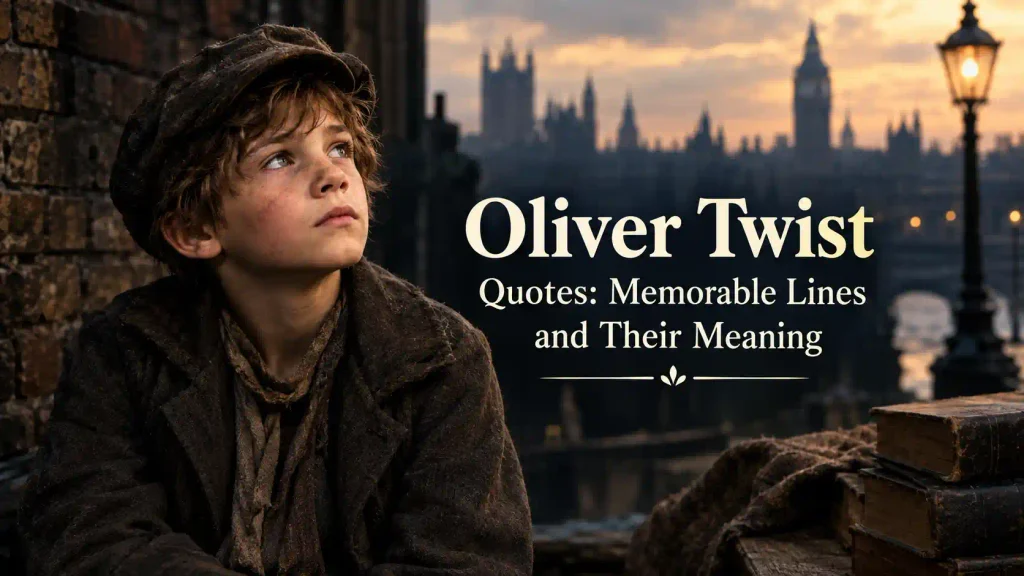

Oliver Twist quotes explore poverty, hunger, kindness, injustice, childhood, and the fight to survive in a world that often treats vulnerable people unfairly. Charles Dickens’s famous novel offers plenty to discuss, from Oliver’s difficult childhood to the contrast between cruel adults and people who show genuine compassion. This collection includes original quote-style lines inspired by the novel’s themes, along with ideas for captions, school assignments, literary discussions, and social media posts. These newly written lines are not verbatim quotations from Dickens’s book.
Published in 1838, Oliver Twist remains a powerful story about a young orphan facing hardship in Victorian England. Its characters and events raise questions about poverty, morality, social responsibility, and the meaning of a good life.
If you are looking for a thoughtful caption, a starting point for an essay, or a short line that captures the spirit of the story, the sections below offer different ways to express its central ideas.
1. Oliver Twist Quotes About Poverty and Hunger 🍞
Poverty is one of the central themes of Oliver Twist. Oliver’s experiences reveal how hunger can become a daily struggle and how a society can fail children who need protection. These original lines reflect the hardship, dignity, and human needs at the heart of the novel. Use them for reflective captions, classroom discussions, or writing about social inequality.
- Hunger makes every ordinary day feel like a battle.
- A poor child deserves more than another empty promise.
- Empty bowls can reveal a society’s deepest failures.
- Poverty should never decide a child’s worth.
- The smallest meal can become someone’s greatest hope.
- Hard times test people who never chose their struggles.
- No child should have to beg for basic kindness.
- Wealth means little when compassion is missing.
- Behind every hungry face is a story worth hearing.
- A full table means less when others starve nearby.
- Need is not a crime, and kindness is not charity alone.
- Some burdens begin before childhood has a chance to bloom.
- A person’s value cannot be measured by their possessions.
- The cruelest poverty is being treated as invisible.
- A fair world begins when nobody is forgotten.
The novel’s portrayal of deprivation also encourages readers to think beyond individual circumstances. Oliver’s suffering is not simply a result of bad luck. Dickens exposes the social attitudes and institutions that make life harder for children who have little power over their futures.
When discussing poverty in an essay, connect the theme to the treatment of orphans, the harsh conditions Oliver faces, and the difference between those who offer help and those who exploit his vulnerability. For a social media caption, choose a short line about dignity or compassion rather than treating suffering as something romantic.
2. Oliver Twist Quotes About Kindness and Compassion ❤️
Kindness offers a sharp contrast to the cruelty Oliver encounters. Some characters take advantage of his innocence, while others recognize his humanity and offer him a chance at safety. These original lines focus on empathy, generosity, and the quiet ways people can change another person’s life. They work well for thoughtful posts, friendship messages, and discussions about the novel’s moral lessons.

- One kind choice can interrupt a lifetime of cruelty.
- Compassion sees a person before it sees their circumstances.
- A gentle heart can survive a harsh world.
- Kindness matters most when nobody expects a reward.
- Protecting the vulnerable is a measure of true character.
- A little patience can restore someone’s faith in people.
- Goodness speaks clearly without demanding an audience.
- Help offered freely can change the direction of a life.
- The smallest act of care can outlast a grand speech.
- Choose mercy when power makes cruelty easy.
- A safe home begins with people who truly care.
- Real generosity gives dignity along with assistance.
- Listen closely, because quiet suffering deserves attention.
- The world grows kinder whenever someone refuses indifference.
- Being good means doing right when it costs something.
Kindness in Oliver Twist is more than a pleasant quality. It helps distinguish characters who respect others from those who view vulnerable people as tools for personal gain. The contrast also makes the moments of genuine care feel especially important.
For a literature assignment, you can use these lines as starting points for exploring how Dickens develops moral contrasts between characters. If you are writing a personal caption, a line about helping without expecting anything in return may fit a post about volunteering, supporting a friend, or appreciating someone who stood by you.
Remember that kindness does not always require a dramatic rescue. In the world of the novel, even a small gesture can matter because so many people have become accustomed to looking away.
3. Oliver Twist Quotes About Justice and Social Inequality ⚖️
Dickens challenges a society that judges poor people harshly while allowing powerful individuals to escape responsibility. Oliver’s treatment exposes the gap between what society claims is fair and what vulnerable children actually experience. These original lines capture that tension and suit essays about Victorian society, social reform, and the relationship between poverty and justice.
- Justice loses its meaning when only the powerful receive it.
- A fair law must protect the powerless, too.
- Society reveals its values through the people it neglects.
- Punishing the desperate will never cure desperation.
- Rules without mercy can turn suffering into punishment.
- Every child deserves protection beyond the words of a law.
- The truth matters even when it challenges authority.
- A respectable appearance cannot hide an unjust heart.
- Fairness begins when status stops deciding whose voice matters.
- Blaming victims is easier than confronting broken systems.
- No institution deserves trust without accountability.
- The poor need opportunity, not another lesson in shame.
- A just society makes room for second chances.
- Power becomes dangerous when nobody questions its use.
- Real progress begins when unfair treatment is no longer accepted.
One of the novel’s enduring strengths is its criticism of institutions that claim to help the poor but often deepen their suffering. Dickens invites readers to examine the difference between offering genuine assistance and enforcing rules without empathy.
For students, this theme can support an essay about the workhouse system, class divisions, or the treatment of children in nineteenth-century England. A strong discussion should connect the novel’s fictional events to Dickens’s portrayal of social attitudes rather than assuming that every detail represents all Victorian experiences.
For a caption or short post, a line about accountability or fairness can communicate the theme without requiring readers to know the entire plot. These lines are especially useful for book-club discussions about whether a society should judge people by their circumstances or help them overcome those circumstances.
4. Oliver Twist Quotes About Hope, Courage, and Survival 🌟
Oliver experiences fear, uncertainty, and repeated disappointment, yet his story continues to leave room for hope. His journey shows how difficult it can be to preserve one’s sense of right and wrong when the surrounding world offers so few safe choices. These original lines express resilience without pretending that hardship is easy or that every problem can be solved by determination alone.
- Hope can survive even the longest season of hardship.
- Courage sometimes means enduring one more difficult day.
- A painful beginning does not decide the ending.
- Survival is an achievement nobody should have to prove.
- Keep your values when the world tests your patience.
- Even a small chance can open an unexpected door.
- Fear may follow you without getting to lead you.
- A difficult road can still lead somewhere better.
- Strength sometimes looks like asking someone for help.
- Tomorrow deserves a chance to surprise you.
- Innocence can endure without becoming blind to cruelty.
- Starting over takes courage, not certainty.
- Hold on to goodness without denying the world’s darkness.
- A setback is part of the journey, not its definition.
- Hope grows when someone finally offers a way forward.
Oliver’s story is not a simple lesson about staying positive. His circumstances are often shaped by forces beyond his control, including the decisions of adults and the dangers of his environment. That makes the moments when he receives help particularly meaningful.
The theme of survival can be useful when writing about resilience in literature. Consider how Oliver responds to frightening experiences, how other characters influence his path, and why the possibility of a safer future matters so much to him.
For a personal status or book caption, choose a line that reflects the kind of hope you want to express. Some lines focus on endurance, while others emphasize accepting help or beginning again. The best choice depends on whether you want to celebrate personal strength, encourage someone facing difficulty, or reflect on the novel’s emotional journey.
5. Oliver Twist Quotes About Innocence, Childhood, and Growing Up 🕊️
Oliver’s childhood is shaped by experiences that no young person should have to face. Rather than enjoying security and guidance, he must navigate a world where adults frequently control his future. These original lines explore childhood innocence, responsibility, and the need to protect young people. They are suitable for literary reflections, educational posts, and discussions about children’s rights.

- Childhood should be a time of discovery, not fear.
- Every young heart deserves room to feel safe.
- Children need guidance, not exploitation.
- Growing up too soon steals moments that cannot return.
- Innocence is not weakness, and trust is not foolishness.
- A child’s silence does not mean a child’s suffering is small.
- Adults reveal their character through how they treat children.
- No young life should be traded for another person’s gain.
- Safety gives children the freedom to imagine tomorrow.
- Every child deserves to be heard without fear.
- Protecting innocence requires more than good intentions.
- Childhood needs patience, shelter, and room to grow.
- A young person’s mistakes should not erase their dignity.
- Children should inherit possibilities, not the burdens of adults.
- The measure of care is how well the vulnerable are protected.
The treatment of children is central to the emotional impact of Oliver Twist. Oliver has limited control over where he lives, whom he encounters, and what happens to him. His vulnerability makes the choices of the adults around him especially important.
For an essay, explore how Dickens contrasts Oliver’s innocence with the greed, cruelty, and manipulation displayed by certain characters. You can also discuss how the novel challenges readers to question a society that expects children to endure conditions they cannot reasonably change.
These lines may also work as captions for posts about child welfare, education, or the importance of a safe home. If you use one in an educational setting, make it clear that the wording is an original reflection inspired by the novel, rather than a sentence taken directly from the book.
6. Oliver Twist Quotes About Good and Evil, Morality, and Human Nature 🖋️
Oliver Twist asks readers to consider what makes someone good or cruel. Characters are shaped by their choices, circumstances, desires, and relationships, yet the novel repeatedly highlights the harm caused when people treat others as disposable. These original lines offer a way to discuss moral responsibility, hypocrisy, greed, and the power of choosing to do what is right.
- A good reputation cannot replace a good conscience.
- Cruelty often begins when another person becomes a convenience.
- Greed sees opportunities where compassion sees human needs.
- Character is revealed when kindness brings no personal benefit.
- A dishonest act can wear an honest-looking disguise.
- Good intentions mean little without responsible choices.
- The heart grows colder whenever suffering becomes entertainment.
- Nobody becomes admirable by making others feel small.
- Temptation tests values that easy days never challenge.
- A person’s past should inform judgment, not erase humanity.
- Moral courage means refusing to follow a cruel crowd.
- Evil often grows when ordinary people stop asking questions.
- A gentle nature is not permission to be mistreated.
- True goodness requires both empathy and action.
- The choices we make reveal more than the image we present.
The novel presents morality through the contrast between people who exploit Oliver and those who treat him with care. Dickens also exposes hypocrisy, particularly when outward respectability hides selfish or harmful behavior. This makes the book useful for examining how appearances can differ from a person’s actions.
For literary analysis, look at the ways characters use power, money, fear, or deception to influence others. Ask whether the novel presents morality as a matter of reputation or as something demonstrated through conduct. You can also consider how Oliver’s own innocence functions as a contrast to the behavior of those around him.
If you are choosing a quote for a social media post, think about the point you want to make. A line about hypocrisy may suit a reflection on dishonesty, while one about moral courage may work better for a post about standing up for someone. A thoughtful caption is often more effective when it communicates one clear idea rather than trying to cover every theme in the novel.
Frequently Asked Questions About Oliver Twist Quotes
What is Oliver Twist about?
Oliver Twist is a novel by Charles Dickens about an orphan boy who faces poverty, mistreatment, and danger in Victorian England. His experiences expose social inequality while exploring compassion, morality, and the possibility of finding safety and belonging.
Who wrote Oliver Twist?
Charles Dickens wrote Oliver Twist. The novel was first published in serial form between 1837 and 1839, with a book edition appearing in 1838.
What are the main themes of Oliver Twist?
The main themes include poverty, childhood innocence, social injustice, crime, kindness, morality, and the treatment of vulnerable people. Dickens uses Oliver’s experiences to question social attitudes and institutions that fail to protect those in need.
What is the famous Oliver Twist quote about asking for more?
The best-known line associated with Oliver’s request for more food is “Please, sir, I want some more.” Oliver speaks these words in the workhouse after receiving an inadequate meal. The moment becomes a memorable turning point because his simple request challenges the harsh authority of the adults responsible for feeding the children.
This is a brief quotation from Dickens’s novel, unlike the original quote-style lines in the six collections above.
Why is Oliver Twist important in English literature?
The novel is important because it combines memorable characters and dramatic storytelling with criticism of poverty, institutional cruelty, and social inequality. It remains widely studied for its Victorian setting, moral questions, and portrayal of a vulnerable child’s experiences.
Can I use Oliver Twist quotes for Instagram captions?
Yes. You can use short lines inspired by the novel’s themes to create book captions, reading updates, or reflective posts about kindness, justice, and hope. If you need an exact quotation from Dickens, check the original text and preserve the wording accurately. Clearly label newly written, theme-inspired lines so readers do not mistake them for passages from the book.
How do I choose an Oliver Twist quote for a school essay?
Start with the point you want to explain. For an essay about social inequality, focus on poverty and justice. For a discussion of character, consider innocence and morality. Then support your argument with a verified passage from the novel and explain how its wording, context, and character relationships support your interpretation.
Conclusion
Oliver Twist continues to matter because its story asks readers to look beyond appearances and recognize the humanity of people facing hardship. Its themes of poverty, kindness, justice, childhood, and moral responsibility offer plenty of material for reflection, discussion, and writing.
Use these original lines as caption ideas or starting points for exploring Dickens’s message. If you need a quotation for an academic assignment, return to the novel for the exact passage. Choose the line that best expresses your perspective, share it with fellow readers, and let the story inspire a thoughtful conversation.